
In short
A yacht insurance survey is an independent inspection of a yacht’s structure, machinery, safety equipment and compliance. Insurers use it to decide whether to cover the vessel, and on what terms. The surveyor reports on condition and risk and lists any work needed to keep the yacht insurable.
If your yacht is based in Athens, Piraeus or elsewhere in Greece, your insurer or broker may ask for a survey in several situations: before a new policy, at renewal, after a change of owner or cruising area, or after a major refit. This guide covers when that request usually comes, what the surveyor checks, how to prepare and what the report gives your underwriter.
When do you need a yacht insurance survey?
You need one when your insurer asks for it. Requirements differ between insurers, policies and vessels, so check your policy wording or ask your broker before you book. The most common triggers are:
- A new policy. Many insurers ask for a survey before they first cover a yacht, particularly a larger or older one.
- Renewal of an older yacht. Once a yacht passes an age set by the insurer, a survey at renewal, and periodically after that, is a common condition of cover.
- A change of ownership. A new owner is often asked for a current survey, even if the previous owner had one.
- A new cruising area or use. Extending from Greek coastal waters to the wider Mediterranean or beyond, or starting charter work, can prompt a new survey.
- After a major refit or repair. The insurer may want confirmation that the structure and systems are sound once the work is finished.
Age limits and survey intervals are set by each insurer. Confirm yours before booking, and pass the surveyor any instructions or forms the insurer provides.
What does a yacht insurance survey cover?
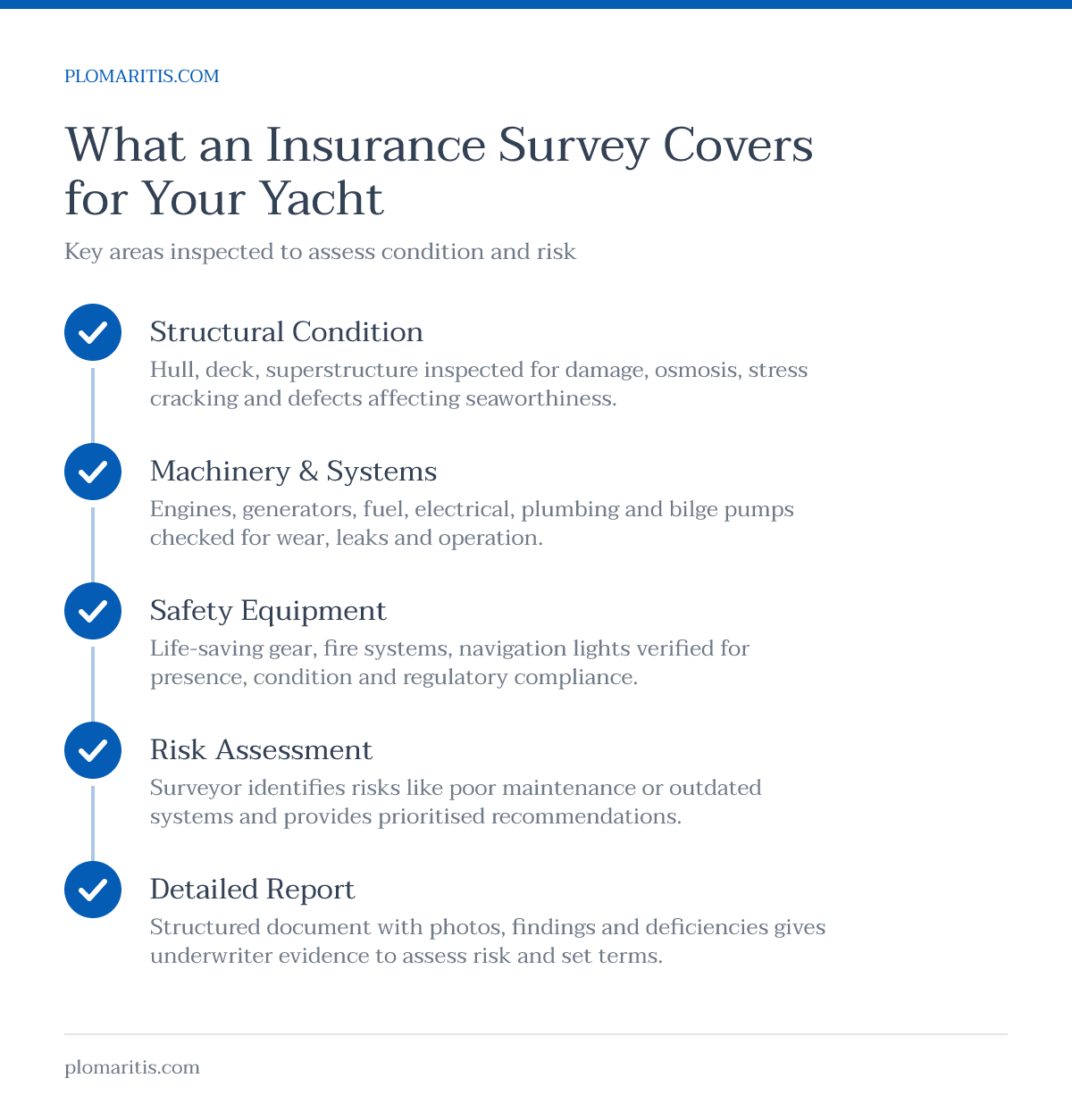
An insurance survey gives the underwriter a clear, defensible record of the vessel’s condition, its risks and any corrective action needed. The exact scope depends on the vessel and the insurer’s instructions. It usually covers four areas.
Structure, hull and visible defects
The hull, deck, superstructure and internal structure are examined for damage, deterioration, osmosis, stress cracking and other defects that could affect seaworthiness or lead to a claim. This includes through-hull fittings, keel, rudder and steering gear.
Machinery and onboard systems
Main engines, generators, fuel, electrical and plumbing systems, bilge pumps and other installations are checked for condition, operation and maintenance. Leaks, corrosion, wear and equipment that doesn’t work are recorded.
Safety equipment and compliance
Life-saving and fire-fighting equipment, navigation lights, ground tackle and other safety equipment are checked for presence, condition and service dates. They are also checked against the regulations that apply to the vessel.
Risk exposure and recommendations
The surveyor identifies anything that raises the risk of loss or damage, such as overdue maintenance, outdated systems or non-compliance, and sets out prioritised recommendations. These tell the owner and the insurer what is needed to bring the yacht to an acceptable standard.
Strong sun and UV in Greek waters wear paint systems quickly, so the condition of topside and underwater coatings is also noted. For a full assessment of a paint system, see our coating inspections.
What the survey report gives your underwriter
The report is an impartial, structured document. It describes the vessel and its general condition, includes photographs and findings on structure and systems, and summarises defects with prioritised recommendations.
For the underwriter, the report is the evidence used to assess risk and decide on cover and terms. It may list items to fix before cover starts or within a set period. It also records the yacht’s condition on a known date, which helps if a claim is made later.
For you as the owner, the report shows exactly what the insurer will see. It also gives you a clear list of work to keep the yacht insurable and safe.
Some insurers ask for a condition and valuation (C&V) survey, which adds an opinion of market value to the condition report. If yours does, say so when you book, so the valuation survey can be done on the same visit.
How to prepare for an insurance survey
A little preparation shortens the visit and avoids gaps in the report. Before the survey:
- Send the surveyor the insurer’s instructions or survey form, and your deadline.
- Have the registration documents, previous survey reports and maintenance or refit records ready.
- Gather service records for the liferaft, fire extinguishers and other safety equipment.
- Make sure engine spaces, lockers, bilges and the lazarette are accessible, and that the yacht has power.
- Tell the surveyor about any known issues or recent repairs.
- Ask your insurer whether they need the yacht inspected out of the water. If they do, book the haul-out with the yard in advance.
Time on board and cost depend on the yacht’s size and type, where she lies, whether a haul-out is needed and what the insurer asks for. You receive a clear scope and quotation before the survey is confirmed.
Insurance survey vs pre-purchase, damage and valuation surveys
Each survey answers a different question for a different person.
| Survey | Commissioned by | When | Main purpose |
|---|---|---|---|
| Insurance survey | Owner, at the insurer’s request | New policy, renewal, change of owner, area or use | Condition and risk record for underwriting |
| Pre-purchase survey | Prospective buyer | Before buying | Whether the yacht is worth buying, and at what price |
| Damage survey | Owner or insurer | After an incident | Cause, extent and repair scope of the damage |
| Valuation survey | Owner, lender or insurer | Insurance, finance or sale | An independent market value |
Pre-purchase survey
A pre-purchase survey is commissioned by a buyer deciding whether to buy and at what price. It is usually wider in scope than an insurance survey, often with a haul-out, a sea trial and a closer look at machinery, and it searches for hidden defects that affect value. If you are buying and insuring at the same time, ask your insurer whether a recent pre-purchase report will be accepted. It may save a second visit.
Damage survey
A damage survey follows an incident such as a grounding, collision, fire or storm. The surveyor documents the cause and extent of the damage and defines the repair scope for the claim. It responds to an event and is not a routine condition check.
Valuation survey
A valuation survey establishes an independent market value for insurance, finance or sale. It can overlap with an insurance survey, but its main output is a figure for agreed-value or market-value cover rather than a condition report.
Insurance surveys in Athens, Piraeus and the Greek islands
Insurance surveys are carried out by Panagiotis Plomaritis, an independent yacht surveyor and naval architect based in Marousi, Athens. He has more than 30 years in the yacht industry and previously headed the yacht department at Damen Shipyards. He is an IIMS Associate and a member of YDSA and RINA, and every instruction is covered by professional indemnity insurance. Read more about Panagiotis.
- 30+ years’ experience
- IIMS Associate
- YDSA member
- RINA member
- PI insured
We attend yachts in marinas, at anchor and in shipyards across Greece, and arrange haul-outs with the yard when needed. Regular locations include:
- the Athens Riviera marinas: Alimos, Flisvos, Zea Marina and Vouliagmeni
- Piraeus, Perama, Salamina and Lavrion
- Syros, Mykonos, Corfu, Lefkada, Rhodes and Crete
See all yacht survey locations in Greece.
We are fully independent. We do not sell yachts, carry out repairs or take commissions from yards, so the report reflects the yacht’s condition and nothing else.
Frequently asked questions
It is an independent inspection of a yacht’s structure, machinery, safety equipment and compliance, used by an insurer to decide on cover and terms. The report records condition and risks and lists any work needed.
In most cases the owner instructs and pays the surveyor, and the report goes to the insurer or broker. Check your policy or ask your broker if you are unsure.
Not always. Many insurance surveys are carried out afloat, but some insurers ask for an out-of-water inspection of the hull, especially on older yachts. Check the insurer’s instructions before booking.
It depends on the yacht’s size, complexity and access. The time on board and the report date are confirmed when the scope is agreed.
The report lists them with prioritised recommendations. Your insurer decides what must be fixed and by when, and some items may be a condition of cover. Once the work is done, the insurer may ask for evidence or a follow-up check.
Sometimes. Some insurers accept a recent pre-purchase or C&V report instead of a separate insurance survey. Ask your insurer before booking, and tell the surveyor so the report covers what they need.
Arrange your insurance survey
If your insurer has asked for a survey, send us the vessel details, where she lies and the insurer’s requirements. A short call confirms the scope, timing and location, so the report meets your needs and your underwriter’s.